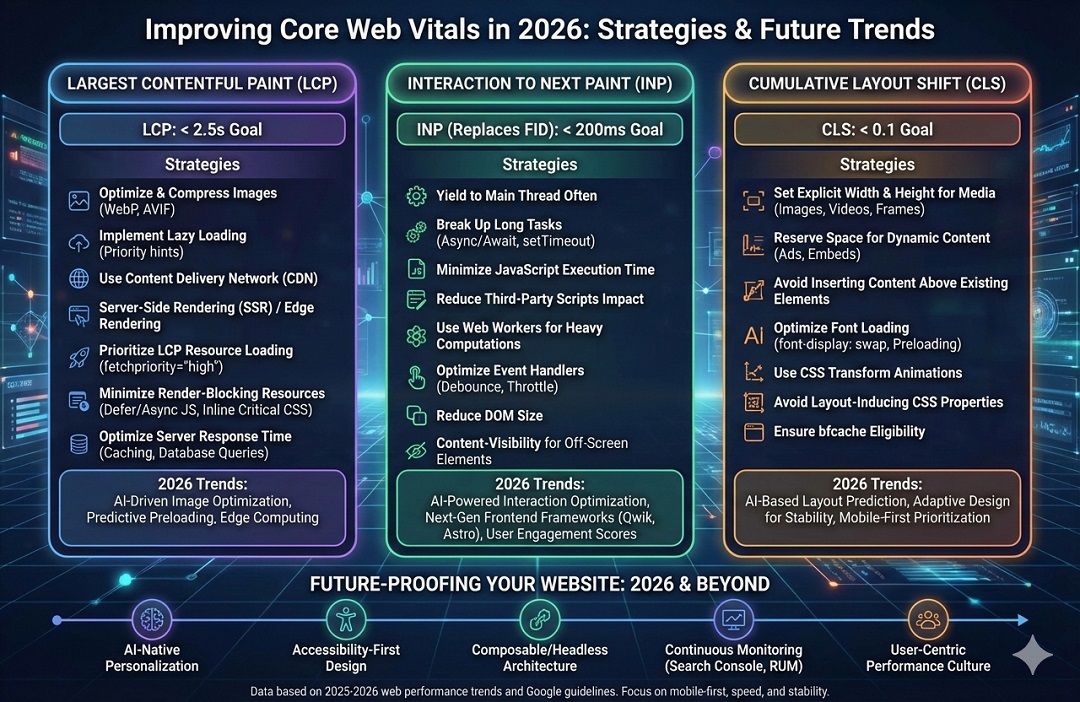
How to Improve Core Web Vitals in 2026
In the year 2026, the success of websites depends very much on their speed, stability, and user experience. Now, search engines and AI-based platforms give preference to websites that load quickly and operate smoothly on every device. Core Web Vitals is where the whole matter becomes crucial. These metrics of performance assist in evaluating the real-time-user-experience of a website. If your site is lagging or its performance is erratic, the users will not have faith in it and the rankings will fall. At Webquick India, we are committed to performance-driven web development that not only caters to real users' problems but also enhances the overall quality of the website.
Improving Core Web Vitals is not just about technical SEO—it is about creating a better experience for visitors. Faster loading pages, quick user interactions, and stable layouts help reduce bounce rates and increase conversions. With the right web development strategies, image optimization, and mobile-first approach, businesses can meet Google’s 2026 performance standards. Webquick India helps brands optimize Core Web Vitals to achieve better rankings, stronger visibility, and long-term digital growth.
What Are Core Web Vitals? (Easy Explanation)
Core Web Vitals are performance metrics created by Google to measure how real users experience your website.
These metrics do not focus on design—they focus on:
- Speed
- Responsiveness
- Stability
In 2026, Core Web Vitals include three main metrics:
- LCP – Largest Contentful Paint (Loading speed)
- INP – Interaction to Next Paint (User interaction speed)
- CLS – Cumulative Layout Shift (Visual stability)
If these metrics are poor, your website will:
- Rank lower on Google
- Perform poorly on mobile
- Lose user trust
- Get fewer leads and sales
Why Core Web Vitals Are Important for SEO in 2026
1. Direct Impact on Google Rankings
Core Web Vitals are integral to Page Experience signals, which have a direct effect on SEO performance—particularly in competitive niches.
2. Visibility in AI Overview
AI systems tend to favor websites that:
- Have fast loading times
- Are simple to crawl
- Provide seamless user experience
A slow website is less likely to be cited in AI-generated answers.
3. Business Growth
- Speedy websites result in a lower bounce rate
- Good UX leads to a higher conversion rate
- Consistent design = increased trust
Core Web Vitals integrate SEO, UX, and web development.
Understanding Core Web Vitals in Detail
1. Largest Contentful Paint (LCP)
What Is LCP?
LCP signifies the time required for the principal content of your webpage to become visible.
This could be:
- An impressive image
- A glance at a banner
- A huge title
LCP Ideal Score
- Good: Less than 2.5 seconds
- Needs improvement: 2.5–4 seconds
- Poor: More than 4 seconds
Typical LCP Issues
- Images not compressed and of large size
- Web hosting server is slow
- CSS which is rendering-blocking
- Website themes that are heavy
How to Improve LCP in 2026
Image Optimization
- WebP or AVIF format
- Compress images so that the quality remains unaffected
- First load the images above the fold
Server Speed Improvement
- Use really fast cloud or SSD hosting
- Activate server-side caching
- Decrease Time to First Byte (TTFB)
Get Rid of Resources that Block Rendering
- Include critical CSS
- Postpone non-vital scripts
- Don't load excess assets
At Webquick India, image and server optimization alone improves LCP by up to 40–60%.
2. Interaction to Next Paint (INP)
What Is INP?
INP measures how fast your website responds when a user clicks, taps, or types.
It replaced FID because it gives a realistic user interaction score.
Ideal INP Score
- Good: Under 200 ms
- Needs improvement: 200–500 ms
- Poor: Above 500 ms
Why INP Is Poor on Many Websites
- Heavy JavaScript files
- Too many third-party tools
- Poor frontend optimization
- Unoptimized frameworks
How to Improve INP (Developer-Level Fixes)
Reduce JavaScript Execution
- Remove unused JS
- Break large JS bundles
- Use modern build tools
Load Scripts Properly
- Use async and defer
- Delay analytics and tracking scripts
Optimize Frontend Frameworks
- Reduce unnecessary re-renders
- Use server-side rendering
- Follow performance best practices
👉 INP is the most technical Core Web Vital and requires expert web development skills.
Cumulative Layout Shift (CLS)
What Is CLS?
CLS measures how much your website moves unexpectedly during loading.
Example:
- User tries to click a button
- Page shifts suddenly
- Wrong click happens ❌
Ideal CLS Score
- ✅ Good: Below 0.1
- ❌ Poor: Above 0.25
Common CLS Causes
- Images without size attributes
- Ads loading without space
- Fonts loading late
- Dynamic banners
How to Fix CLS in 2026
Always Define Image Size
- Set width and height
- Use CSS aspect-ratio
Optimize Fonts
- Use font-display: swap
- Preload main fonts
- Avoid loading too many font styles
Reserve Space for Ads & Widgets
- Use placeholders
- Avoid sudden layout changes
Mobile-First Core Web Vitals (Very Important)
In 2026, mobile traffic dominates.
Google measures Core Web Vitals mainly from mobile users, even for desktop searches.
Mobile Optimization Tips
- Responsive design
- Lightweight mobile UI
- Fewer animations
- Touch-friendly buttons
- Real-device testing
Mobile-first web development = better rankings and user satisfaction.
Technical SEO + Core Web Vitals (Strong Connection)
Core Web Vitals work best when combined with technical SEO.
Important Technical Fixes
- Clean website structure
- Fast and secure HTTPS
- Proper internal linking
- Schema markup
- Crawl-friendly JavaScript
Search engines and AI tools trust technically clean websites more.
Best Tools to Measure Core Web Vitals
Always track performance before and after optimization.
Recommended Tools (2026)
- Google Page-Speed Insights
- Search Console Core Web Vitals Report
- Lighthouse
- Chrome UX Report
Data-based optimization gives long-term results.
Common Core Web Vitals Mistakes to Avoid
- Using cheap hosting
- Installing too many plugins
- Ignoring mobile performance
- Overusing animations
- Not testing after updates
These mistakes reduce rankings and conversions.
How Webquick India Helps Improve Core Web Vitals
Webquick India does not rely on shortcuts.
Our Enduring Method:
1. Core Web Vitals audit
2. Performance bottleneck analysis
3. Web development-level fixes
4. Technical SEO optimization
5. Mobile performance tuning
6. Continuous monitoring
We create websites that are blazing fast, stable, SEO-friendly, and compatible with AI.
Final Conclusion
In 2026, Core Web Vitals are a foundation of successful SEO and web development.
If your website:
- Loads fast
- Responds instantly
- Stays visually stable
Then Google, AI tools, and users will trust your site.
Webquick India helps businesses turn slow websites into high-performing digital platforms that rank, convert, and grow.
FAQs – How to Improve Core Web Vitals in 2026
1. What are Core Web Vitals in simple words?
Core Web Vitals are performance signals used by Google to check how fast, responsive, and stable a website feels for real users. They help Google understand whether users are having a good or bad experience on your website.
2. Which Core Web Vitals matter in 2026?
In 2026, Google focuses on three Core Web Vitals:
- LCP (Largest Contentful Paint) – measures loading speed
- INP (Interaction to Next Paint) – measures interaction speed
- CLS (Cumulative Layout Shift) – measures visual stability
All three are important for SEO and user experience.
3. Do Core Web Vitals really affect Google rankings?
Yes. Core Web Vitals are part of Google’s Page Experience ranking factors. Websites with good Core Web Vitals usually rank higher, get better visibility, and perform well in competitive searches.
4. What is a good Core Web Vitals score in 2026?
A website is considered good when:
- LCP is under 2.5 seconds
- INP is under 200 milliseconds
- CLS is below 0.1
These scores indicate a fast and user-friendly website.
5. Why is my website slow even after good content?
Good content alone is not enough. A website can be slow because of:
- Heavy images
- Poor server performance
- Un-optimized JavaScript
- Too many third-party scripts
This is why Core Web Vitals optimization is essential along with content.
6. How does web development affect Core Web Vitals?
Web development plays a major role in Core Web Vitals. Clean code, optimized JavaScript, proper image handling, and fast server response help improve website speed, interaction, and stability.
7. Is mobile Core Web Vitals more important than desktop?
Yes. Google mainly uses mobile Core Web Vitals data for ranking. If your website performs poorly on mobile, it can affect rankings on both mobile and desktop searches.
8. Can Core Web Vitals help in Google AI Overview ranking?
Yes. Websites with good Core Web Vitals are more likely to be trusted and referenced by Google AI Overview and AI-based search answers, because they provide fast and reliable user experience.
 our blog

 Webquick
India
Webquick
India
 11 May 2026







 How It works